Showing posts with label Books. Show all posts

18/05/2014

May

Im wunderschönen Monat Mai,
Als alle Knospen sprangen,
Da ist in meinem Herzen
Die Liebe aufgegangen.
Heinrich Heine


... Maar het werd wonderzoet
Te zien, toen Mei daarin haar armen stak,
Ontwakend, oprijzend, zich op het vlak
Van hare handen steunend dat gekraak
Kwam van de schelpen -- op haar teere kaak,
Vochtig van slapen, schoot een zonstraal schuin,
Dat het bloed beefde, van den rand van 't duin.
...
Zij danste rond en heel de wei had baat,
En ook de beek, want als een springfontein
Die een kolom spuit, maar in drupplen klein
Gemaakt wordt, zoo viel bij haar schouders neer
Een vlucht gebloemte. En telkens wierp ze weer,
De lucht blies ze open. ...
Gorter, Mei


Veris laeta facies
mundo propinquatur.
Hiemalis acies
victa iam fugatur.
in vestitu vario Flora principatur,
nemorum dulcisono
quae cantu celebratur.
Orff, Carmina Burana: Veris laeta facis


May is
like
well nice
innit
Bristol, Song of the Month


17/04/2014

April

Whan that aprill with his shoures soote
The droghte of march hath perced to the roote
And bathed every veyne in swich licour
Of which vertu engendred is the flour;
Whan zephirus eek with his sweete breeth
Inspired hath in every holt and heeth
Tendre croppes, and the yonge sonne
Hath in the ram his halve cours yronne
And smale foweles maken melodye,
That slepen al the nyght with open ye
(so priketh hem nature in hir corages);
Thanne longen folk to goon on pilgrimages...

The Canterbury Tales, Geoffrey Chaucer

April is a very exciting month. Winter, the season of impatient anticipation, dragging its heels like the thief of happiness in a tussle with a clumsy but ultimately victorious police sergeant, is on its way out. Chaucer had it right, I think, and Walt Disney wasn't far wrong either.


View on YouTube

The excitement of April is gloriously evident in the garden, as everything is literally budding with promise and potential. Swelled by sun and gradually increasing daylight hours, the world is thinking about being verdant, presaging the lush and floral month of May with the tender and tentative signs of first growth.


It's time to sow the bulk of summer crops, the sort of things which grow while you watch. My borlotti and french beans - soaked overnight, sowed in good compost and kept in the warm - were already piercing the surface within five days and perceptibly bursting out and straining upwards by the hour.

It's also time to build on your keenness of earlier months and prick out onions, tomatoes, and whatever else you thought you were mad enough to sow in the wet months of winter.

Nothing beats the taste of homegrown tomatoes; eating them properly ripe makes your realise what a poor excuse shop bought tomatoes are. OK, the artificial preservation/unripening of shop bought tomatoes (which certainly have more food miles than seeds) means that we can 'enjoy' tomatoes from January through to, well, January. But in securing year-round supplies of toms, shops compromise so much in flavour.

I'm growing beef tomatoes this year, which I'm pretty excited about. You can pay up to a pound per tomato for beef varieties in the shops, which can make a round of stuffed toms fairly pricey. So I'm looking forward to being quids-in with these beasties.

I potted them up the other day and revelled in that bizarrely seductive smell of bruised tomato stems. (Tomatoes are in the blood. My great grandad was a nurseryman on Guernsey before the war; his family, including my Nan, were evacuated; he survived Nazi occupation by growing greenhouse tomatoes.)

Some things are a slower burn. My dad and I went to a local nursery last autumn, and ate all the blackcurrants off a bush there and then. They were perfectly ripe, warm from the sun, and had only a slight hint of pesticide. Out of guilt and gluttony, or intoxicated by a lethal mix of vitamin C and noxious chemicals, we bought a bush. I pruned it back once the leaves had fallen, and took all of the prunings as cuttings.


There's an odd thrill as you watch a cutting take root. At times, its future hangs in the balance; it could rot from the soil upwards - or flourish with lush green leaves.


April is a time to take stock, too. So far, it is proving that the preparation - the pruning, dismantling of fences, scrubbing of greenhouse panes in soggy latex gloves, the weeding and digging of sodden soil in the cold light of January - has been worth it after all.

10/01/2013

E. M. Forster's Collected Short Stories

There's a strange, irrational defensiveness which creeps over people when something they like is picked apart. We know that it shouldn't matter what someone else dislikes, but it bothers us; as a feeling, it's started wars in its time.

So perhaps my reaction of dismay when someone told me that they didn't rate E. M. Forster suggests that he is one of my all-time favourite authors.

I suppose what I like most about his writing is the contemplative humanism, often communicated through wit and irony, which pervades his works. Yes, Where Angels Fear to Tread may have a simple, almost predictable narrative - but there is so much insight there, so much which holds a mirror up to society and remains valid to this day: ironic but nuanced exposés of class and custom; meditative deconstructions of commonly held assumptions.


Contemplative humanism


These themes echo through his other works. In A Passage to India and A Room with a View, E. M. Forster doesn't just parody the tourist who can't see past their guidebook, but - quite bravely (for the period) - tackles ingrained social prejudices in cross-cultural encounters, and the consequences for those who break the mould.

And in this way, E. M. Forster's short stories are no different, hosting a cast of intriguingly modern narrators, who paint romantic watercolours with one hand whilst sketching skits with the other. Some, such as The Story of a Panic or The Point of It are anecdotal tales of enigmatic occurrences, which are left open to the reader's interpretation. And often, E. M .Forster blurs the line between realistic and fantastic, imbuing the space with - again, enigmatic - neo-classical references.

Another great power in E. M .Forster's writing is his ability to hold an intriguing narrative whilst elevating the whole piece to a completely abstract plane. For instance, The Other Side of the Hedge tells the tale of a man who walks a path and is one day tempted to look on the other side of the hedge.. but the story becomes a near-parabolic deconstruction of Progress with a capital P - I probably need to add: in a good way. Similarly, The Celestial Omnibus is a surreal tribute to Poetry and Romanticism, through the vehicle of, well, the Celestial Omnibus.

But one of E. M. Forster's real masterpieces comes in the form of The Machine Stops. I first became aware of it (quite ironically) through Stephen Fry on Twitter, when he posted a link to a free online version of the text. (There are plenty of online sources for the text, if you google, but I read it, and all the other short stories, in the 1954 Penguin paperback). Set in a world where humans only interact through the Machine, humanity's self-constructed life-support mechanism, the tale is almost more relevant today (with our increasing dependence on technology and communication through social media) than when it was first published, and it is well worth the read.

I can say no more than that I heartily recommend E. M. Forster's short stories, and that if you have liked his longer prose, you are sure not to be disappointed.

03/10/2012

Reviewing Arthur: A Few Thoughts

It perhaps goes without saying that a reader's taste in literature is entirely subjective. To my mind, though, there are some books which, by nature, aren't as thrilling as the rest. Some simply doesn't have the universal narrative hooks to entice, challenge, and intrigue the reader (say, a legal textbook, dictionary, or the more rambling tracts of Serbian post-modernism). Some perhaps would have excited a certain interest-group at the time the book was written - but no longer plug into the sockets of modern-day culture. The eternal postivist in me says that, rather than cast aside such literature, we have to assume that it spoke to its contemporary audience in some way - and work out why.

What really gets me, though, is when a reviewer slates a book from this second group, without attempting to understand the sockets into which it would have plugged (i.e. ... context). Perhaps this is the sort of thing which is only sacrilege to a Medievalist. Or to someone who does know the context. I don't know. Maybe I should put down my dangerously-poised pen, and say 'each to their own'.


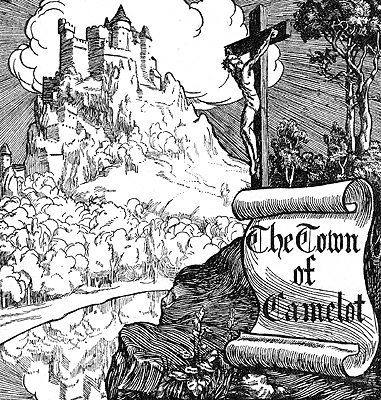
http://www.earlybritishkingdoms.com/arthur/images/camelot.gif
Nonetheless, this negative review of the Penguin edition of Chrétien de Troyes' Arthurian Romances illustrates my point:
If you have time - and if you're about to read this book you must have it to burn - please indulge me in my offer of an introduction to Chrétien de Troyes as an alternative to the overreverent and numbingly serious one offered by Penguin. I do so not because I feel Chrétien's work lacks value. To the contrary, it's without doubt a cultural treasure, offering an insight into the sensibilities and preoccupations of its time. It's more because if you're about to spend the long, long time it is going to take you to read the work, you deserve a health warning. And maybe one of those Parental Guidance stickers Tipper Gore wasted so much time inventing, instead of doing something worthwhile like her old man did and campaigning for some cleaner air.
Firstly: what? Since when has the length of a book been a reason not to read it? What does Tipper Gore have to do with anything? And I can confirm that Penguin's edition boasts a mere 521 pages, including introduction, five individual romances, and notes. Some would call that value for money.
One particularly shocking realisation from reading Chrétien's account is that, far from being a great English hero, Arthur is in fact very French. As, of course, was England itself at the time. So possibly one of the more interesting perspectives the Arthurian Romances give us is of England as an extension of France, with Arthur trundling off for extensive stays in Brittany, leaving the estate in the care of one of his counts. Even whilst in England, Arthur lives anywhere but Camelot, he is marginal to most of the stories, and Merlin, Avalon, Excalibur and other elements of the English popular legend are conspicuous by their almost total absence (actually, Excalibur is in the hands of Gawain, not Arthur), although Guinevere's extra-curricular activities with Lancelot are as in-your-face as it gets: apart from being peripheral, Arthur is also a big time cuckold.
Is any of this really shocking, or at least worthy of the accusatory tone? Admittedly, Geoffrey of Monmouth's earlier Historia Regum Britanniae (c. 1136) features Merlin, but Chrétien doesn't seem to have used this as his source in the Story of the Grail (c. 1181-1191). And if you've been brought up on a staple diet of the twentieth-century Arthurian pop-fic which does draw on Monmouth's Arthur, the lack of Merlin and Avalon in Chrétien's romance would perhaps be conspicuous. But to criticise the twelfth-century author for not including these elements is a little bit like reading Pride and Prejudices and Zombies, and then complaining that Ms Austen's Mansfield Park doesn't cast enough characters as semi-dead.


http://fr.wikipedia.org/wiki/Fichier:Eleonora_Jindra2.jpg

Another example, this time for Penguin's edition of the anonymous Quest of the Holy Grail, got my metaphorical (and, hey, literal) goat:

This story of the legend of the Grail is considered one of the key works on that subject, but it failed to inspire me to saddle-up and take part in the quest. I had heard that this anonymous work from the early 13th century was rich in Celtic symbolism, but I failed to see that. What I saw was a far more Christian text where lofty ideals lead seekers to the most holy of relics. Galahad, the hero of the tale, is so devout and pure that it was very hard to relate and empathise with him. I much preferred Lancelot, whose sin of lust barred his way to a vision of the Grail. He seemed a much more realistic character, but his love of a woman sees him flounder on the quest.
There was also a distinct lack of bad guys and battles to keep us entertained, which made it seem like an action film without a car chase! There was no Mordred or Klingsor to get our blood racing and that leaves the book rather stale. However, it’s not all bad news. I believe every book has a redeeming feature and this is no exception. When King Arthur realises the quest for the Grail will break-up the Round Table, he calls his knights to Camelot for one last gathering, one last noble joust. His short meditation on this is one of my favourite quotes from any Holy Grail book. Knowing many brave knights will die on the quest, he says 'Gracious lords, we have now clear proof that you will embark very soon on the Quest of the Holy Grail. And because I know that I shall never again see you all assembled as you are today, I would have in the meadows of Camelot a tournament so splendid that after our death our heirs will talk of it still'.
I might look like a pedant of the worst and most incorrigible variety, but this review illustrates my point, dots the Is, and crosses the Ts. Although the reader acknowledges the context (lofty Christian ideals), he still holds completely anachronistic twenty-first-century expectations of Hollywood-style battles. Hey, this text was as ripping as it got for monks in the thirteenth century; why bemoan the lack of zombies?


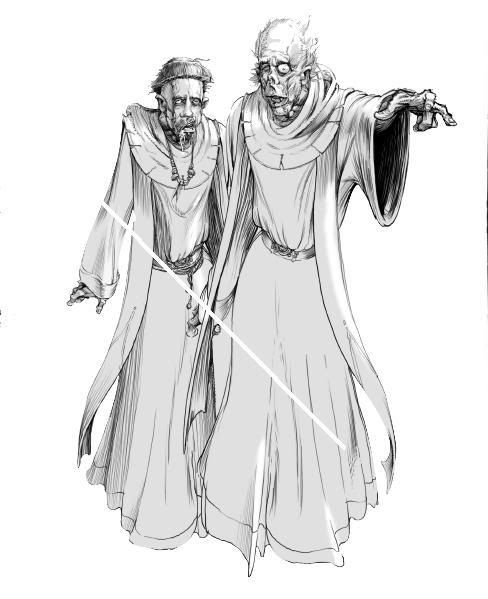
Zombie Monks
http://i31.photobucket.com/albums/c355/Balgin/Doodles/Grim/zombiemonks.jpg

But all of this got me thinking. We're left in a bit of a quandry: can we only really enjoy a text if we understand its context and frame of reference? Should we only save medieval texts from the skip if they press semiotic buttons which which still work 800 years later? Nine times out of ten we don't (want to) have to read the author's biography to know what they're on about and why. But this certainly explains why so many literature students start off hating a work, before eventually singing its praises...

11/02/2012

Tales of the Obscure (Other Language Authors #1)

Image: penguin.com.au

If English readers have heard the name E.T.A. Hoffmann, it is most likely in the context of his most famous work, Der Sandmann (The Sandman), and its reception in Freud's essay on 'The Uncanny'. 

Telling the tragic account of the protagonist Nathanael's madness and death, Der Sandmann interweaves fairy-tale fantasy à la Brothers Grimm with a profound insight into human psychology and the forces of the elusive 'unconscious'. However, investigations into the darker sides of human nature are not just found in this one novella - this recurrent theme is part of what makes Hoffmann's whole oeuvre such a compelling read.

At the heart of Der Sandmann is a tale of childhood trauma. We discover early on that, when he was young, Nathanael had covertly seen his father and a lawyer named Coppelius at work on alchemy – shocking enough – but had then seen his father killed in an explosion, and Coppelius steal devilishly away. As a result, Nathanael associates the lawyer with the fabled Sandman, who steals the eyes of children who won't go to bed, and feeds them to his children in the moon.

Herr Hoffmann himself
(A fairly likely story, I'd say).

The effects of this overpowering childhood experience reverberate throughout the novella: when he encounters the barometer and glasses maker, Coppola, the grown-up Nathanael believes him to be Coppelius in disguise. The theme of eyes (or fear of losing them) forms something of a motif – Coppola's glasses, the telescope Nathanael uses to spy on his beloved Olimpia, the hollowness of her sockets because she is effectively a robot, the telescope at the look-out tower from where Nathanael falls to his death, having sighted Coppelius...

Freud defines the uncanny as the reappearance of something with which one was once familiar, but has since been repressed, and the recurrence of Coppelius-figures and prosthetic eyes are the very manifestations of Nathanael's repressed trauma which may send a shiver down our collective spine. 

Not only does this suggest that E.T.A. Hoffmann had a great insight into how to create gripping and uncanny narrative fantasies, but also shows his understanding of the effects of trauma and mental illness. Certainly, eyes come back to haunt Nathanael; but the severe 'hysterical' fit the protagonist suffers when he takes out Coppola's telescope and sees Coppelius demonstrates Hoffmann's acknowledgement of a quite explicit link between trauma, external stimuli which evoke the repressed, and pantomime/illness responses to them. In this respect, he was well ahead of many of the physicians of his time.

Almandin (Image: webmineral.com)
But we should not judge E.T.A. Hoffmann just on the merits of one novella. If Der Sandmann explores the unconscious in the form of repressed trauma, Die Bergwerke zu Falun (The Mines of Falun) goes one step further, by examining repressed desires. At the start of the novella, we meet Elis Fröbom, a man depressed after his mother's death, unwilling to go back to sea, from where he has just returned. As the tale goes on, Elis is driven on towards the Mines of Falun by unknown, mysterious forces, unseen hands, and the uncannily recurrent figure of the old miner Torbern – all of which seem to be figments and projections of his own increasingly distorted imagination. He falls in love with the beautiful Ulla Dahlsjö, and they become engaged - but on the day of their wedding, Elis disappears down the mine in search of the near-mythically scarce Almandine stone, never to resurface.

The centre of Falun, Sweden
There are fairly strong insinuations of Oedipal desire throughout Die Bergwerke zu Falun, with Elis' relationship to his mother described in ambiguously sexual terms. Consequently many have interpreted Elis' attraction to the mines of Falun as representative of his attraction to a womb-like orifice of The Symbolic Mother, and have seen the search for Almandine as the attempt to express this unutterable desire. The fact that Elis has a dream in which his beloved Ulla doubles up with his mother and the imaginary 'Queen' of the Mines of Falun, makes it clear that this is not just the retrospective product of nebulous psychoanalysis; E.T.A. Hoffmann was, in fact, surveying the territory which Freud would go on to popularise in the early twentieth century.

Through Die Bergwerke zu Falun and Der Sandmann, Hoffmann created something of an aesthetic sensation by combining portrayals of madness with the concise poetic prose of the novella. Looking back, we can also perceive the seedlings of so many ideas concerning the human mind which would only become 'popular' in the early twentieth century. But even if you're not on the look out for the uncanny (or E.T.A Hoffmann's understanding of human psychology. Or trauma. Or repression. Or Oedipus), Hoffmann's writing style – enigmatic, fantastic, utterly compelling – makes his novellas well worth the read.